


For much of the past decade, Indian mattress manufacturers focused on building scale at home. Expanding distribution networks, strengthening brands and increasing production capacities were natural priorities in a market that offered abundant opportunities. The industry’s success story was shaped largely by domestic demand.
The narrative is beginning to broaden. As manufacturers invest in technology, enhance operational capabilities and expand production capacities, overseas markets are becoming an increasingly important part of long-term business strategy. With India already established among the world’s leading exporters of mattresses and bedding products, the focus is shifting from participation in global trade to strengthening its position within it.
The timing is significant. From hotel developments in the Gulf and housing growth across Africa to expanding consumer markets in Southeast Asia, demand for bedding products continues to rise across several regions. At the same time, evolving sourcing strategies are creating fresh opportunities for manufacturers with the scale, quality standards and reliability required to serve international customers.
Historically, exports occupied a relatively small place in the growth strategies of most mattress manufacturers. India’s domestic market was large enough to absorb production capacities, encouraging companies to focus on strengthening distribution networks and expanding market share within the country. Today, that equation is beginning to change. As the industry matures, manufacturers are exploring international markets as a means of diversifying revenue streams, improving capacity utilisation and reducing dependence on a single market. Exports also offer companies the opportunity to benchmark themselves against global standards and enhance their competitiveness. For many businesses, international markets are no longer viewed as occasional opportunities but as a potential pillar of long-term growth.
Recent shifts in global sourcing strategies have prompted buyers to diversify their supplier base. Geopolitical uncertainties, supply-chain disruptions and the need to reduce dependence on a limited number of sourcing destinations have encouraged many international companies to look beyond traditional manufacturing centres. This trend has created opportunities for countries capable of offering reliable manufacturing, competitive costs and improving quality standards. India is no longer a newcomer to mattress exports. The country has emerged as one of the leading exporters of mattresses and bedding products globally, supported by a growing manufacturing base and increasing acceptance in international markets. Trade data compiled by the Observatory of Economic Complexity (OEC) places India among the world’s leading mattress-exporting nations. In 2024, India exported mattresses worth approximately US$659 million, making it the third-largest exporter of mattresses globally, behind China and the European Union, holding a 3.41% global market share. As international buyers diversify their sourcing strategies, Indian manufacturers have an opportunity to establish themselves as credible long-term partners.
While comprehensive global rankings for 2025 are yet to be published, available trade data indicates continued momentum in India’s mattress exports, with shipment volumes recording strong year-on-year growth and demand emerging from markets such as the UAE, Nepal and parts of Eastern Europe.
For an industry that has already demonstrated its ability to scale rapidly in the domestic market, participation in evolving global supply chains could become an important avenue for future growth.
Markets beyond India
The export market presents significant opportunities for India’s mattress industry, though transportation costs remain a key challenge, according to M.T.P. Mohamed Kunhi, Managing Director of Sulfex Mattress Company, one of the country’s leading mattress manufacturers. “In a container shipped to Dubai, we can export mattresses worth only about Rs 6–8 lakh, whereas the same container can carry textile products worth nearly Rs 40 lakh,” he said. “Despite this limitation, we are already exporting mattresses and are exploring opportunities to further expand our presence in the Gulf countries, Africa and the Maldives.”
Mohamed Kunhi noted that higher raw material costs in India compared to China also affect export competitiveness, giving Chinese manufacturers an advantage in global markets. At the same time, he believes there is considerable scope to strengthen export infrastructure. Referring to logistics, he pointed out that exporters operating through Kochi Port often face procedural delays that can affect shipment schedules and costs. “Compared to ports in Tamil Nadu and Gujarat, Kochi Port has certain bureaucratic hurdles, and the resulting delays can impact exports,” he said.
He also added that streamlining procedures and improving turnaround times at the port would help exporters from Kerala take better advantage of growing opportunities in international markets. Among potential export destinations, the Middle East continues to attract significant attention. Ongoing investments in residential developments, commercial projects and hospitality infrastructure are generating demand for home and lifestyle products, including mattresses.
Geographic proximity also offers logistical advantages compared to more distant markets. Africa is emerging as another region of interest. Rapid urbanization, population growth and the expansion of middle-income households are contributing to demand for modern household products. While market conditions vary considerably from one country to another, many industry observers see long-term potential across selected African markets. While freight costs remain a challenge, innovations in packaging and logistics are helping improve the export viability of mattresses, according to Jayadevan D.S. (Jay), a business development manager and consultant based in Kenya. “Although volume remains a key consideration in mattress exports, many companies are overcoming this challenge by adopting vacuum-compressed, boxed mattresses,” he said. “Packaging innovations such as vacuum compression and the use of 40 HQ containers are helping improve the economics of mattress exports. Improved space utilisation during transportation can make a significant difference to freight costs and enhance competitiveness in international markets.”
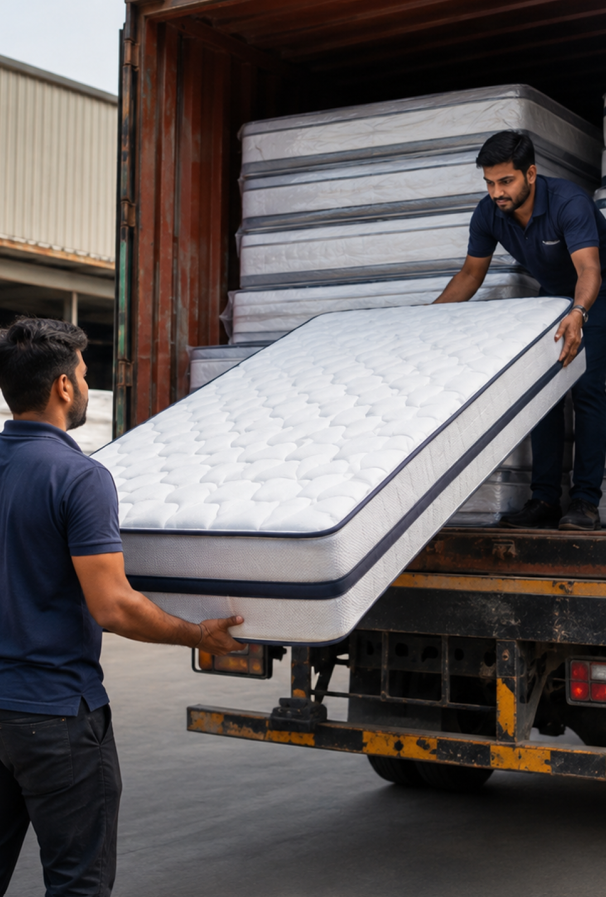
While the long-term prospects remain positive, exporters are navigating a challenging global environment, according to Srinivasan Sundaresan, Secretary of the Indian Sleep Products Federation (ISPF). “India has emerged as one of the world’s leading mattress exporters and continues to see opportunities across several international markets,” he said. “However, the industry is currently operating amid geopolitical tensions in West Asia, tariff-related concerns and supply-chain challenges. Since mattresses are bulky products, logistics efficiency and packaging innovation remain critical to export competitiveness.” Sundaresan said the industry remains optimistic about the medium-term outlook despite current global uncertainties. “The present export environment remains challenging, but we expect demand to improve in the second half of the financial year,” he said. “Traditionally, the period from October to March sees stronger demand, supported by festive buying and seasonal factors in key markets. Manufacturers that focus on quality, innovation and operational efficiency will be well positioned to benefit from the growing demand for sleep products worldwide.”
Identifying opportunities, however, is only the first step. Sustained success depends on understanding what international customers expect and adapting accordingly. Hotels, resorts, serviced apartments, student accommodation projects and institutional facilities often purchase mattresses in substantial volumes. Such projects can provide manufacturers with an opportunity to establish a presence in new markets while building valuable references for future business. The Middle East, in particular, continues to witness significant investments in tourism and hospitality infrastructure, while similar trends are visible in parts of Africa and Southeast Asia. At the same time, hospitality customers often have demanding expectations. Product consistency, durability, delivery schedules, warranty support and after-sales service all influence purchasing decisions. Manufacturers seeking to serve this segment must be prepared to meet these expectations consistently.
Building a sustainable export presence
While hospitality projects can provide an effective entry point, not every manufacturer entering overseas markets needs to build International retailers, hospitality suppliers and bedding brands frequently seek reliable manufacturing partners capable of producing mattresses according to specific requirements. This approach allows manufacturers to gain export experience, increase production volumes and develop long-term customer relationships without making substantial investments in overseas marketing and brand development. Over time, some companies may choose to transition from OEM production to developing their own international brands. Others may find that contract manufacturing itself offers a sustainable and profitable export model.
While the Gulf presents significant opportunities for Indian mattress exporters, premium hospitality brands often operate with highly specific bedding standards and product specifications, according to Joby Sebastian of Le Méridien Dubai, part of the Marriott Group. “Across our properties, bedding specifications are standardised according to brand requirements. As a result, manufacturers are often asked to produce mattresses locally rather than import them,” he said, adding that Indian brands nevertheless enjoy growing recognition in Gulf markets. He says. Regardless of the route to market, one of the most important lessons in export business is that customer preferences are rarely universal. Comfort expectations vary significantly across regions. Mattress firmness, dimensions, material choices and construction methods often differ from one market to another. A product that performs well in India may require modifications before it can succeed elsewhere.
Successful exporters invest time in studying consumer behaviour, retailer expectations and market-specific requirements. They recognise that international success often depends as much on adaptation as on manufacturing capability. Understanding local preferences, however, is only part of the equation. India’s manufacturing advantages are frequently highlighted as a competitive strength. While cost competitiveness certainly matters, it is rarely the sole factor influencing purchasing decisions. International buyers increasingly evaluate suppliers based on a broader set of criteria. Product quality, delivery reliability, responsiveness, consistency and service support often carry as much weight as price. This is particularly true in the mattress industry, where customer satisfaction depends on long-term product performance. Buyers want assurance that every shipment will meet agreed specifications and deliver consistent quality.
Manufacturers seeking to build sustainable export businesses must therefore focus on overall value rather than cost alone. Manufacturing technology is becoming an increasingly important differentiator in international markets. Automated production systems, advanced testing facilities and robust quality-control processes enable companies to deliver greater consistency and reliability. International buyers often assess not only the product itself but also the systems and processes behind its manufacture. Investments in automation can improve efficiency, reduce variability and strengthen confidence among overseas customers. Similarly, testing and quality assurance systems help manufacturers demonstrate compliance with customer expectations and international standards. As export markets become more demanding, technology is likely to play an increasingly important role in determining competitiveness.
Environmental considerations are steadily influencing purchasing decisions across global markets. Institutional buyers, hospitality groups and large retailers are paying greater attention to product materials, manufacturing practices and packaging solutions. Mattresses produced using environmentally responsible processes and sustainable materials are attracting growing interest.
In some markets, sustainability has moved beyond branding and become part of procurement criteria. Buyers increasingly seek products that align with their environmental objectives and corporate sustainability commitments. For manufacturers exploring international opportunities, sustainability may become an important factor in strengthening market access and differentiation.
Export success often depends on more than manufacturing capability. Many international buyers require specific certifications, product testing and compliance documentation before engaging with suppliers. These requirements may vary by market and customer segment, but they frequently play a crucial role in establishing credibility. Although obtaining certifications requires investment and preparation, it can significantly enhance access to larger customers and institutional projects. As manufacturers expand their export ambitions, compliance with internationally recognised standards is becoming an increasingly important component of business strategy.

One of the biggest misconceptions about exports is that success begins and ends with shipping products. In reality, building a meaningful presence in overseas markets requires sustained market development. Local distributors, channel partners and institutional relationships often play a decisive role in long-term success. Understanding local retail structures, customer expectations and regulatory environments usually requires strong partnerships on the ground. Developing these relationships takes time, but they can provide valuable market insights and support business growth. Trade exhibitions, buyer-seller meetings and international networking platforms also continue to serve as important avenues for identifying opportunities and establishing connections. The growth of compressed mattress technology and bed-in-a-box formats is creating new possibilities for exporters. Digital marketplaces and cross-border e-commerce platforms enable manufacturers to reach consumers directly in selected international markets. While logistics, customer service and returns management remain important considerations, digital channels offer an additional route to market beyond traditional retail networks.
As online furniture and home-product sales continue to expand globally, e-commerce may become an increasingly relevant component of export strategies. Despite the positive outlook, exporting remains a complex undertaking. Freight costs, currency fluctuations, regulatory changes and market-specific competition can all influence profitability. Conditions that appear favourable today may evolve over time, requiring manufacturers to adapt their strategies accordingly.
Success therefore requires disciplined planning, careful market selection and a willingness to invest in long-term relationship building. Companies that approach exports as a strategic commitment rather than a short-term sales opportunity are often better positioned to navigate these challenges.
India’s mattress industry has already demonstrated its ability to evolve in a rapidly changing domestic market. Manufacturing capabilities have improved, product portfolios have expanded and companies have become increasingly focused on quality, innovation and customer experience. These developments provide a strong foundation for exploring opportunities beyond India’s borders.
Yet exports cannot be viewed simply as an extension of domestic business. International markets demand a different mindset, one that combines manufacturing excellence with market understan-ding, operational discipline and long-term commitment. The next decade may determine whether India remains primarily a large domestic mattress market or emerges as a significant global supplier of sleep products. The capabilities are steadily falling into place. The companies that invest early in quality systems, certifications, market intelligence and international partnerships may be best positioned to capture the opportunities that lie beyond India’s shores.
Industry in 5 Minutes
- Expanding into international markets allows to hedge against domestic seasonal slumps while accessing fast-growing regions such as Asia-Pacific, North America, and the Middle East.
- India’s strong manufacturing base in natural fibers combined with competitive labor costs provides a unique value proposition for eco-friendly and premium organic mattress segments globally.
- Tying up with large global retail chains offers a reliable volume channel for bulk supply.
- Participation in global expos & strategic alliances allows for larger brand exposure
- Establishing trust and brand recognition against established global giants requires meeting strict local environmental, fire-retardant, and safety regulations.