

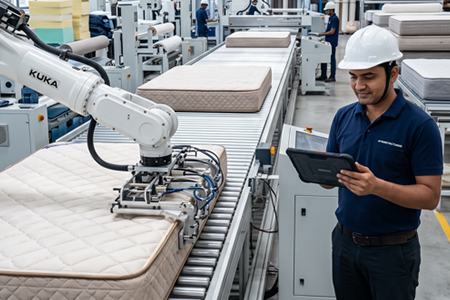
India’s mattress industry is undergoing a significant transformation. Rising disposable incomes, urbanization, expanding housing markets, and growing awareness about the importance of sleep have collectively propelled the sector into one of the fastest-growing segments of the home furnishings industry. Consumers today are no longer purchasing mattresses merely as household necessities, they increasingly view them as wellness products that contribute directly to health, comfort, and quality of life.
This shift in consumer perception has created new opportunities for manufacturers. At the same time, it has introduced new challenges. Product expectations are rising, quality standards are becoming more demanding, competition is intensifying, and supply chains are growing more complex. Manufacturers are expected to deliver consistent quality, introduce innovations more rapidly, optimize costs, and respond quickly to changing consumer preferences. Despite these evolving market dynamics, many manufacturing processes within the mattress industry continue to rely heavily on traditional methods. Quality inspections are often manual. Production planning is frequently based on experience and historical trends. Inventory management and procurement decisions are commonly guided by spreadsheets and intuition. While these approaches have served the industry for decades, they may not always provide the speed, precision, or scalability required in a highly competitive marketplace.
Artificial Intelligence (AI) is increasingly emerging as a technology that can address many of these challenges. Across industries ranging from automotive and electronics to textiles and consumer goods, AI is helping manufacturers improve efficiency, reduce waste, enhance quality control, and make better business decisions. The mattress industry is uniquely positioned to benefit from many of these developments.
Rather than replacing human expertise, AI has the potential to strengthen it by providing manufacturers with better visibility, faster insights, and greater operational control. For mattress manufacturers seeking sustainable growth, AI may become an important enabler of competitiveness in the years ahead.

Environmental considerations are becoming increasingly important across manufacturing industries, driven by customer expectations, regulatory developments, and corporate sustainability commitments.
Transforming manufacturing through intelligence
The mattress manufacturing process involves numerous stages, including raw material procurement, foam processing, spring assembly, quilting, stitching, packaging, warehousing, and distribution. Each stage presents opportunities for optimisation, and AI can contribute across the value chain. One of the most immediate applications is quality assurance. Traditionally, quality checks depend on trained inspectors who visually examine products for defects. While experienced personnel remain indispensable, manual inspection can sometimes be influenced by fatigue, variations in judgement, or production pressures.
Computer vision systems powered by AI offer an additional layer of precision. Using cameras and image-recognition algorithms, these systems can monitor production lines continuously and identify irregularities in fabric stitching, quilting patterns, foam dimensions, edge finishing, spring alignment, and packaging quality. Potential defects can be flagged in real time, allowing corrective action before products move further down the production line.
Such systems do not eliminate the need for human inspectors. Instead, they enable inspection teams to focus on verification and decision-making while repetitive monitoring tasks are automated.

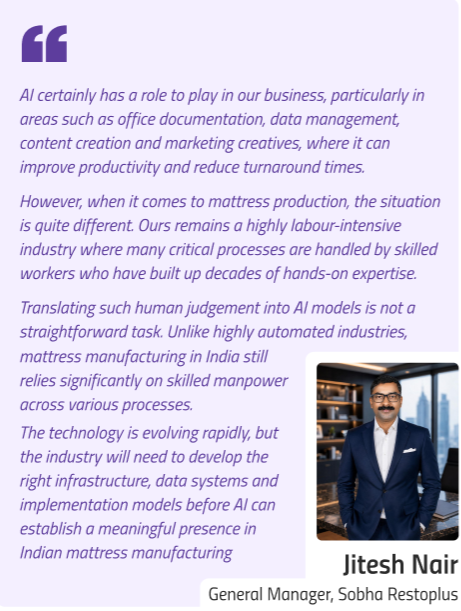
AI is still in its infancy when it comes to broader applications in mattress manufacturing. Developing effective AI models requires significant investment in research and development, along with substantial amounts of production data.
The result can be greater consistency, reduced rejection rates, and lower material wastage. Some manufacturers have already begun experimenting with AI-driven quality systems, though industry leaders caution that widespread adoption will require time and investment. Another important area is predictive maintenance. Manufacturing facilities depend on a wide range of machinery, including cutting equipment, compression units, quilting machines, conveyors, and packaging systems. Unexpected equipment failures can disrupt production schedules, increase maintenance costs, and delay deliveries. AI-driven predictive maintenance systems analyse data from sensors that monitor factors such as vibration, temperature, pressure, and operational performance. By identifying patterns that may indicate equipment stress or potential malfunction, these systems can provide early warnings before a breakdown occurs instead of reacting to failures after they happen, manufacturers can schedule maintenance proactively, reducing unplanned downtime and extending equipment life. For companies operating in increasingly competitive markets, even small improvements in machine availability can contribute significantly to operational efficiency.
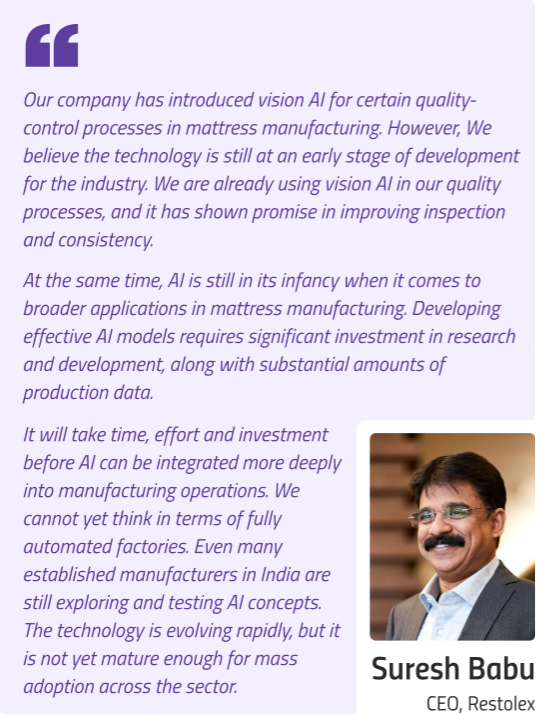
AI can also support production planning. Mattress manufacturers often manage a diverse portfolio of products differentiated by size, material composition, firmness levels, and price categories. Balancing production capacity with fluctuating demand can be challenging, particularly during seasonal peaks. AI-based planning systems can analyse historical sales patterns, order flows, inventory levels, and operational constraints to recommend more efficient production schedules. This can help manufacturers improve capacity utilisation while reducing bottlenecks and excess inventory.
Material optimisation is another promising application. Foam, fabric, coir, latex, adhesives, and packaging materials represent significant cost components in mattress manufacturing. AI-powered optimisation tools can analyse cutting patterns and production workflows to reduce material wastage and improve yield from available resources
Even marginal reductions in waste can generate meaningful savings when applied across large-scale operations. At a time when manufacturers face increasing pressure to manage costs while maintaining quality, such efficiencies can strengthen profitability.
Sustainability is another area where artificial intelligence can create measurable value. Environmental considerations are becoming increasingly important across manufacturing industries, driven by customer expectations, regulatory developments, and corporate sustainability commitments. Mattress manufacturers are also paying closer attention to how materials, energy, and resources are utilised throughout production.
AI-powered monitoring systems can analyse energy consumption across machinery and production lines, helping identify areas where efficiency can be improved. By understanding which processes consume the most energy and when peak loads occur, manufacturers can take informed decisions that reduce both operational costs and environmental impact. The technology can also help monitor material utilisation more effectively. Patterns of waste generation, scrap accumulation, and production losses can be tracked and analysed in greater detail than is possible through manual observation alone. Such insights can support efforts to optimise the use of foam, fabric, coir, latex, and packaging materials.
For larger manufacturers supplying institutional buyers, hospitality projects, or export markets, sustainability reporting is becoming increasingly important. AI can assist in collecting, organising, and analysing operational data required for environmental performance assessments. While sustainability goals vary from company to company, better visibility into resource consumption can support long-term efficiency and responsible growth.
Warehouse management also stands to benefit. AI-enabled systems can improve inventory visibility, monitor stock movement, and recommend replenishment schedules. By providing more accurate information about inventory levels and consumption patterns, manufacturers can reduce excess stock while ensuring material availability for production. The benefits extend beyond operational efficiency. Better visibility across manufacturing processes enables management teams to make more informed decisions, respond faster to challenges, and allocate resources more effectively.
From factory floor to consumer experience
The influence of AI extends well beyond manufacturing operations. As mattress companies increasingly adopt omnichannel sales models that combine retail stores, distributors, e-commerce platforms, and direct-to-consumer channels, data has become a valuable strategic asset.
While discussions around AI often focus on automation, industry leaders believe its greatest impact may come from improving decision-making rather than replacing workers.
According to Gaurav Zatakia, Founder & CEO, Flo Mattress, AI’s most immediate value for the mattress industry lies in helping manufacturers make smarter operational and business decisions. “AI will likely create more value through better decision-making than through direct automation of mattress production. Mattress manufacturing is relatively low-tech compared to industries like automotive or electronics, so the biggest opportunities lie in improving forecasting, planning, quality control, and operational efficiency,” he says, adding, “Over the next few years, I expect AI to help manufacturers better predict demand, optimize production schedules, reduce inventory levels, improve raw material utilization, and identify quality issues before products reach customers. As competition intensifies and margins come under pressure, these improvements can have a meaningful impact on profitability and customer experience.”
Zatakia believes inventory management and demand forecasting are among the areas most ready for adoption today. “Of the three, inventory management and demand forecasting are probably the most ready for adoption and can deliver the fastest return on investment. AI can help manufacturers forecast SKU-level demand, improve procurement planning, and reduce excess inventory while maintaining service levels,” he points out. “Quality control is another promising area, particularly through computer vision systems that can detect defects in foam, fabric, stitching, and packaging more consistently than manual inspection” according to Zatakia.
“Predictive maintenance also has strong potential, especially for larger facilities with continuous foaming lines, quilting machines, and automated packaging equipment, where unexpected downtime can be costly,” he says, adding, “In the near term, I believe the greatest impact of AI in the mattress industry will come from helping manufacturers produce the right product, in the right quantity, at the right time, rather than from replacing people on the factory floor.”
Demand forecasting is one of the most impactful applications in this area. Consumer demand for mattresses is influenced by numerous factors, including housing trends, economic conditions, regional preferences, festive seasons, promotional campaigns, and weather patterns. Predicting these variables accurately is difficult using conventional forecasting methods alone.
AI systems can process large volumes of historical and real-time data to identify patterns that may not be immediately visible through manual analysis. By improving forecast accuracy, manufacturers can better align production, procurement, and inventory

management with market demand. More accurate forecasting can help reduce stockouts, minimise excess inventory, and improve service levels. It can also support better procurement decisions, particularly in periods of volatility affecting raw material prices.
Supply chain management presents another area of opportunity. Mattress manufacturers often source materials from multiple suppliers and distribute products across diverse markets. Managing these interconnected networks requires visibility and responsiveness. AI tools can assist in analysing supplier performance, monitoring logistics flows, identifying potential disruptions, and evaluating alternative sourcing strategies. This can strengthen supply chain resilience and improve overall operational agility. The customer-facing side of the business is equally important. Today’s consumers increasingly seek personalised purchasing experiences. They research products extensively, compare options online, and expect recommendations that reflect their individual requirements. AI-powered recommendation systems can help brands guide consumers toward products that best match their needs. Factors such as sleeping position, body weight, room temperature, health considerations, and personal comfort preferences can all be incorporated into recommendation models.
Such tools can support customers in navigating increasingly complex product portfolios while helping manufacturers communicate the value of different mattress technologies more effectively. Customer engagement is another area where AI is making an impact. Intelligent chatbots and virtual assistants can provide product information, answer frequently asked questions, assist with order tracking, and support after-sales service. These systems can operate around the clock, ensuring timely responses and improving customer convenience.
Importantly, AI-driven customer interactions need not replace human engagement. Rather, they can complement customer service teams by handling routine queries and allowing personnel to focus on more complex or high-value interactions. Product development may also become increasingly data-driven. Manufacturers can analyze customer reviews, warranty claims, service requests, and feedback from multiple channels to gain deeper insights into consumer preferences and recurring concerns.
These insights can support product innovation, helping companies identify opportunities for design improvements, material enhancements, or entirely new product categories. As consumer expectations evolve, data-informed innovation can become an important competitive advantage. Beyond individual applications, one of AI’s greatest contributions may be its ability to improve decision-making across the organisation. Mattress manufacturing is a business that often depends on accumulated experience and practical knowledge. While such expertise remains invaluable, managers today are dealing with a far greater volume of information than ever before.
Production supervisors must monitor efficiency, quality, machine performance, and labour deployment. Procurement teams track raw material availability and pricing trends. Sales teams analyze market demand across multiple channels and regions. Senior management must evaluate performance while planning for future growth. AI can bring these different streams of information together, presenting them through dashboards, alerts, and predictive insights that support faster and more informed decisions. Rather than relying solely on historical reports, managers can gain near real-time visibility into operations and emerging trends. For example, a production manager may receive an early warning about a potential equipment issue, a procurement team may identify an anticipated increase in material demand, or a sales team may detect changing consumer preferences in a particular market segment. Access to timely information can help organizations respond more effectively and reduce the risks associated with delayed decision-making.
Importantly, AI should be viewed as a support system rather than a replacement for skilled employees. The technology can process vast amounts of data, but human judgement remains essential for interpreting information, managing teams, maintaining customer relationships, and making strategic decisions. The most successful implementations are likely to be those that combine technological capabilities with human expertise. The adoption of AI does, however, require thoughtful implementation. Technology alone cannot guarantee success. Manufacturers must invest in data quality, workforce training, process integration, and organisational readiness. Employees need to understand how AI tools function and how they can work alongside them effectively.
CEO Corner
Manoj Sharma, Chief Business Development Officer, Sheela Foam, India
AI has been instrumental in bringing about business efficiencies on the supply side , enabling effective procurement planning, production planning, dispatch planning etc and on the demand side it has enabled quality analysis and highly informed decision making in the shortest of time, enhancing both process efficiencies and output. Business growth can now be achieved despite having to maneuver through ever increasing operating costs and environmental challenges.
Industry in Minutes
- Designing mattresses equipped with contactless bio-sensing tech to monitor metrics like heart rate, breathing patterns, and sleep apnea risks, expanding the market into preventive wellness and remote healthcare.
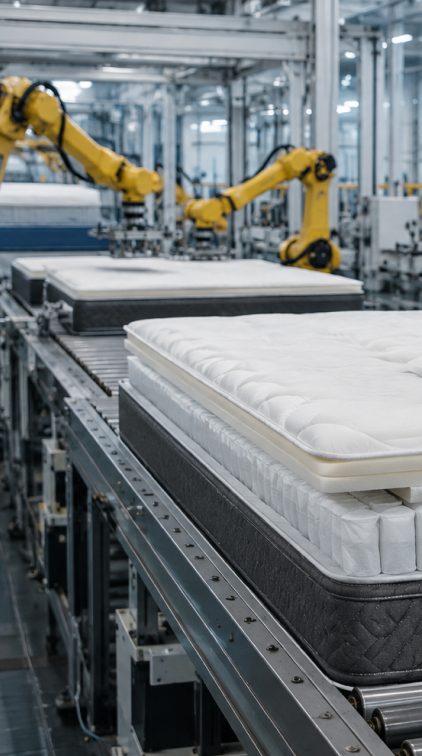
- Factories utilize IIoT (Industrial Internet of Things) combined with predictive AI algorithms to monitor heavy machinery preventing unexpected downtime and ensuring consistent density across batches.
- AI-driven packaging lines optimize compression and vacuum-sealing profiles tailored to varying foam densities, improving storage efficiency and lowering freight costs for direct-to-consumer (D2C) shipping.
- Manufacturers leverage consumer sleep-assessment data to automatically configure customized, multi-layer mattress builds tailored to individual ergonomics.