

In the Indian mattress landscape, a silent revolution is underway, driven by a simple but profound motivator : Pain. Statistics indicate that pain relief is the primary trigger for new mattress purchases in India, leading to a market where over 60% of all mattresses sold now carry the orthopedic label. However, this impressive market share hides a deeper problem of industry integrity.
The ortho label in India has become a catch-all marketing term, often applied blindly to any mattress that feels exceptionally firm. This widespread, non-differentiated offering of hard mattresses highlights a core fallacy that firmness is synonymous with support. In reality, a mattress that is too hard can be as detrimental to spinal health as one that is too soft, creating intense pressure points that fail to account for the body’s natural S-curve.
The myth of firmness : Why hard isn’t always healthy
For decades, the Indian consumer was taught that a firm surface was the only way to treat a bad back. This cultural conditioning has allowed manufacturers to sell basic, high-density coir or bonded foam mattresses under the ortho banner without any clinical validation. Scientifically, however, an orthopedic mattress is defined by its ability to support the skeletal system, particularly the spine, by distributing weight evenly.
When a mattress is too rigid, it does not allow the shoulders and hips, the heaviest parts of the human body to sink in slightly. This forces the spine out of alignment and puts undue stress on the lower back (the lumbar region). True orthopedic support requires contouring, where the mattress adapts to the body’s shape to maintain a neutral spinal position. The modern challenge for the Indian mattress industry is moving from blind labeling to scientific validation, ensuring that a mattress marketed for pain relief actually delivers on its physiological promise.
“An orthopedic mattress should strike a perfect balance, neither too soft nor too firm. Its primary purpose is to maintain the natural S-curve of the spine; a mattress that lacks proper tension can cause the backbone to slump or arch unnaturally. While active individuals with strong core muscles may require less specialized support, many people find that an orthopedic mattress becomes a necessity as they age. Ultimately, back pain is often a lifestyle-related issue, and choosing the right sleep surface is a critical step in long-term spinal health”,says Mr. Deepak Gupta, Managing Director, Duro Mattresses.
The Indian context: The multi-functional sleep surface
In India, the mattress is rarely just a place for sleep; it is an extension of the living room. It is a workstation for a young professional on a laptop, a dining table for a quick meal, and a playground for children. This high-utility usage pattern complicates the orthopedic requirement.
While a mattress must provide spinal alignment for 8 hours of sleep, it must also provide stability for 4 hours of sitting. This has led to a demand for Edge Support and Zero Motion Transfer. If a parent is working on one side of the bed, the ortho mattress must be stable enough that it doesn’t sag under sitting weight, nor should it transfer movement to a sleeping child on the other side. This dual-purpose requirement is uniquely Indian and is forcing brands to rethink their engineering. Nowadays, over 80% of customers walk into my store specifically asking for an Orthopedic mattress. Driven by Instagram reels and online ads, they arrive with a specific brand and model already in mind. Unfortunately, many are unaware of what a true orthopedic mattress actually is. There is a growing trend where some brands market standard foam mattresses as Ortho, which is misleading. A genuine orthopedic mattress requires a specific construction, typically a combination of bonded foam or memory foam with coir or latex. While these high-quality materials make the product more expensive, they are essential for actual support. Despite my efforts to educate them on the right build for their needs, many customers are set on what they saw online. As a retailer carrying 13 different brands, my goal is always to convert visitors into informed buyers, but in the end, we provide exactly what the customer demands, says Dakshina Murthy, Proprietor of Raghavendra Foams and Mattresses, a retailer in Bangalore.
Current industry actions: From marketing to medicine
What is the industry doing to fix the ortho credibility gap? We are seeing a shift toward Zoned Support Systems and Medical Partnerships :
- Zoned support : Rather than a uniform block of foam, brands like Duroflex and Sleepwell are introducing mattresses with 3-zone, 5-zone, or even 7-zone support. These mattresses are engineered to be firmer in the center (to support the heavy pelvic region) and softer at the ends (for the head and legs), mimicking the varied support needs of the human body.
- Medical validation : To combat the blind labeling issue, Indian brands are increasingly seeking endorsements. For instance, Duroflex’s Duropedic range is tested and recommended by the National Health Academy. By involving medical professionals in the R&D process, the industry is trying to transform the mattress from a piece of furniture into a health device.
- Pressure mapping technology : In retail showrooms, brands are beginning to use sensors that map a customer’s pressure points in real-time. This allows the consumer to see exactly where a hard mattress is causing pain and why a contoured mattress provides better relief.

Global brand adoption : The international benchmark
International brands are significantly ahead in integrating technology with orthopedic health. Global leaders are not just selling ortho mattresses, they are selling Sleep Science.
- Sleep Number (USA) : A pioneer in customization, Sleep Number uses SleepIQ technology and air chambers. Users can adjust their Sleep Number (firmness level) every night based on their current pain level or activity. This further then treats orthopedic support as a dynamic need rather than a static one.
- The Sleep Company (India/Global) : By introducing SmartGRID technology, they have disrupted the foam and spring monopoly. The grid structure is soft where you want it and firm where you need it, providing the exact contouring that traditional hard mattresses lack.
- Tempur-Sealy (Global) : Their use of high-density viscoelastic materials (NASA-grade) focuses on pressure redistribution. Their orthopedic range is marketed globally not on firmness, but on the mattress’ ability to eliminate the tossing and turning caused by poor circulation on hard surfaces.
Cross-Industry Lessons :
The mattress industry can find inspiration in other sectors that have mastered the balance between firm support and dynamic comfort.
- The high-performance footwear industry : The evolution of running shoes offers a perfect blueprint. Decades ago, running shoes were simple rubber flats. Today, brands like Nike and ASICS use different densities of foam in the heel and arch to provide motion control. The lesson : A mattress should not be a single material. Like a sneaker, it needs a midsole (the core support) and an outsole (the comfort layer) tailored to the user’s specific biomechanics.
- The ergonomic office furniture industry : Office chairs from brands like Herman Miller are not hard. They are designed with mesh and flexible frames that move with the user while maintaining lumbar support.
The lesson: Support is not stiffness. The mattress industry needs to adopt the concept of dynamic support – surfaces that provide stability while allowing the body to move naturally during the night. - The automotive industry : Luxury car seats (e.g., Mercedes-Benz or Volvo) are engineered for long-distance orthopedic health. They use multi-contour seats with air pockets that can be inflated or deflated to fit the driver’s spine perfectly. The lesson: Customization is the future. If a car seat can adjust to a driver’s back in seconds, a mattress should be able to adapt to a sleeper’s posture throughout the night.
The extended health benefits
In the current age, where office jobs and tech necks are becoming the norm, the quality of our sleep has transitioned from a luxury to a critical medical requirement. While many view a mattress as a mere comfort object, an orthopedic mattress is specifically engineered as a corrective tool designed to support the musculoskeletal system during its most vital recovery phase.
Precision spinal alignment
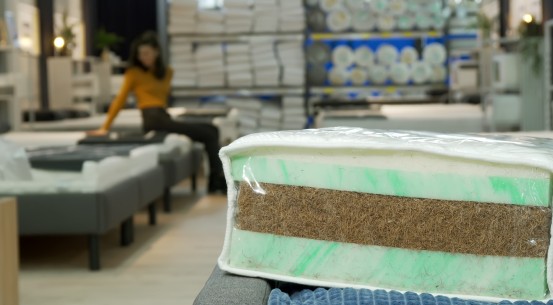
The primary advantage of an orthopedic mattress is its ability to maintain the spine’s natural S-curve. Unlike standard mattresses that may allow the heavy lumbar region to sink, creating a hammock effect. An orthopedic mattress provides targeted resistance. By distributing body weight evenly, it ensures that the vertebrae remain in a neutral position. This reduces the mechanical stress on the spinal discs and prevents the morning stiffness and chronic back pain often associated with poor sleeping surfaces.
Targeted pressure point relief
When you sleep on a surface that is too soft or too hard, the body’s heaviest areas, the shoulders and hips, bear the brunt of the pressure. This can restrict blood circulation and trigger the toss and turn cycle as your brain forces you to move to restore flow. Orthopedic mattresses often feature zoned support. This means the mattress is divided into sections with varying levels of firmness, mainly softer zones at the head and feet and firmer zones to support the spine, helping with uninterrupted sleep.
Improved posture and long-term health
Beyond immediate pain relief, sleeping on an orthopedic surface acts as a form of passive physical therapy. By reinforcing correct posture for eight hours every night, these mattresses help counteract the slouching and misalignment caused by daytime activities. Over time, this can lead to improved blood circulation, better breathing patterns during sleep, and a significant reduction in the risk of developing long-term joint disorders.
Enhanced circulation and reduced edema
Standard mattresses often create hot spots where the body’s weight is concentrated on thin layers of tissue, such as the skin and small capillaries. This pressure acts like a temporary kink in a garden hose, slowing down blood flow. By spreading your weight across a larger surface area, the mattress prevents the compression of blood vessels. This allows for unrestricted blood flow to the extremities. Better circulation means your muscles receive a steady supply of oxygen and nutrients throughout the night. This is particularly beneficial for athletes or individuals with active lifestyles, as it speeds up the repair of micro-tears in muscle tissue.
The future : Smart mattresses and AI
At the start of 2025, the orthopedic mattress is becoming smart. We are seeing the rise of AI-integrated mattresses that use sensors to detect if a sleeper is snoring or if their spine is out of alignment. Some high-end models can automatically adjust their firmness or even tilt the head of the bed to open up airways (addressing sleep apnea, a common comorbid condition with back pain). “It is clear that sleep surfaces have evolved significantly. Today’s market offers new age mattresses specifically designed to enhance comfort and relaxation. While I cannot offer a medical endorsement of any specific brand’s Orthopedic mattress, which is a term many manufacturers use, my recommendation as a medical practitioner is that everyone should sleep on a surface that promotes deep relaxation. Quality sleep is essential for health because it is the body’s primary period for restoration and repair. During deep sleep, the brain triggers the release of growth hormones that repair tissues and build muscle, while the immune system produces cytokines to help fight off infections. Beyond physical repair, sleep acts as a biological housekeeping service for the brain, clearing out metabolic waste and consolidating memories from the day. Without this rejuvenation, the body remains in a state of stress, making it difficult to function optimally the next morning” says Dr. Prashanth, Senior Medical Practioner, Government Hospital, Tumkur. For the Indian market to truly mature, it must move away from the Hard Mattress = Good Back myth. The future lies in certified materials, zoned engineering, and multi-functional durability. As consumers become more educated, the brands that succeed will be those that provide not just a place to sleep, but a scientifically-backed solution for a healthier life.